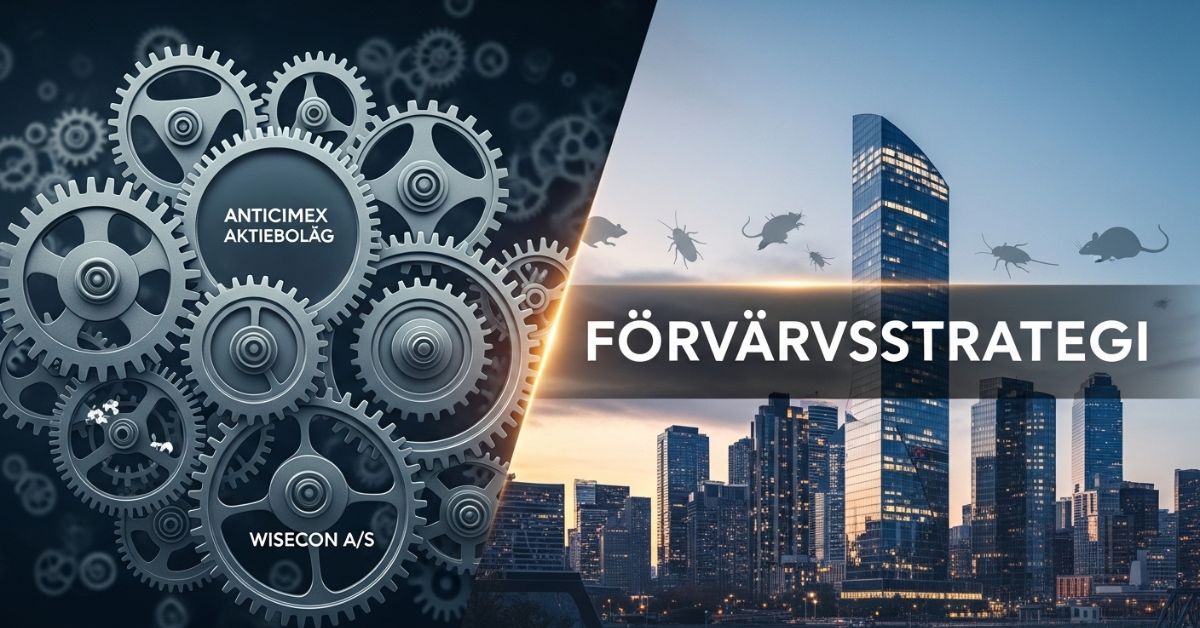
Anticimex Aktiebolag / WiseCon A/S Förvärvsstrategi: How a Calculated Acquisition Approach Is Reshaping the Pest Control Industry
Most people don’t think much about pest control until they need it — and then they need it urgently. But behind the vans, the technicians, and the routine inspections, there’s a corporate story unfolding that has very little to do with rodents and a great deal to do with capital, strategy, and the patience to build something that compounds over time. The Anticimex Aktiebolag / WiseCon A/S förvärvsstrategi is a case study in exactly that kind of disciplined, long-horizon thinking — a blueprint for how targeted acquisitions, executed consistently and integrated thoughtfully, can turn a regional service company into a continental market leader that competitors struggle to follow.
Understanding the Anticimex Aktiebolag / WiseCon A/S Förvärvsstrategi at Its Core
Anticimex Aktiebolag, the Swedish pest and hygiene services group backed by EQT, has spent years executing a growth-by-acquisition strategy across Europe and beyond. The underlying logic is straightforward: the pest control market is highly fragmented, dominated by thousands of small and mid-sized operators with strong local relationships but limited capacity to scale, invest in technology, or weather economic disruption. Anticimex identifies these businesses, acquires them at sensible valuations, integrates them into its operational platform, and uses the combined scale to deliver services more efficiently than any single operator could manage alone.
The WiseCon A/S acquisition fits neatly into this framework. WiseCon, a Danish company known for its digital pest monitoring technology, brought something to the table that pure service companies often lack — a tech-forward product suite that can generate recurring data, reduce manual inspection frequency, and offer clients a more sophisticated service proposition. Folding WiseCon into the Anticimex portfolio wasn’t just a revenue add; it was a capability acquisition, expanding what the group can offer and deepening the competitive moat around its core business.
Why the Förvärvsstrategi Targets Technology-Enabled Businesses
Pest control is not a glamorous sector, but it is a resilient one. Demand holds steady regardless of economic cycles because hygiene and compliance requirements don’t pause during recessions. What is changing, however, is how the service is delivered — and Anticimex has been deliberate about positioning itself on the right side of that shift.
Digital Monitoring as a Strategic Differentiator
WiseCon’s connected monitoring systems represent the kind of asset that becomes more valuable inside a large distribution network. A sensor that detects rodent activity and transmits real-time alerts is useful to a small operator with forty clients. It becomes a platform product when deployed across tens of thousands of client sites, generating data that can train detection algorithms, predict infestation patterns, and give a national operator the kind of service intelligence that no local competitor can replicate. That network effect is central to why Anticimex’s förvärvsstrategi increasingly targets companies with a digital layer, not just a service workforce.
Recurring Revenue and Contract Stickiness
There’s another dimension to the technology focus that matters from a purely financial standpoint. Hardware and software-enabled pest control contracts tend to be stickier than pure service contracts. Once a client has sensors installed, integrated into their building management system, and producing compliance documentation, switching providers means ripping out infrastructure and restarting data history. That switching cost is a moat in its own right — and it makes the acquired revenue base more predictable and more durable than a handshake service agreement ever could be.
The Integration Model Behind the Anticimex Aktiebolag / WiseCon A/S Förvärvsstrategi
Acquisition strategy is only as good as the integration that follows it. Many companies in acquisition-led growth modes stumble not during the deal, but after it — when the cultural friction, system incompatibilities, and competing priorities of the acquired business collide with the acquirer’s existing machine. Anticimex has developed an integration approach that acknowledges this risk directly.
Rather than immediately dismantling the identity and operational structure of acquired businesses, the group tends to preserve local brand presence and client relationships while standardising backend systems, reporting frameworks, and compliance processes. This approach keeps existing customers comfortable — they’re still dealing with the team they know — while capturing the operational efficiencies that make the acquisition worthwhile in the first place. It’s a model that requires patience, but it produces more durable results than aggressive top-down restructuring.
Geographic Expansion as a Pillar of the Förvärvsstrategi
Anticimex’s acquisition activity has never been limited to any single national market. The group has built positions across Scandinavia, the broader European market, and beyond — using each acquisition to deepen density in existing territories or establish a foothold in new ones. The Danish market, where WiseCon was headquartered, is a natural extension of the Nordic base the group built over decades from its Swedish origins.
Geographic density matters in a field service business more than in almost any other sector. When a company has enough technicians spread across a region, route efficiency improves, response times shorten, and the cost per service visit falls. Acquiring a well-positioned local operator doesn’t just add revenue — it compresses the route economics for the entire surrounding territory. Over time, this geographic compounding is what makes the Anticimex model increasingly difficult for a new entrant to challenge.
What the Anticimex / WiseCon Deal Signals for the Broader Industry
For the pest control sector as a whole, the Anticimex Aktiebolag / WiseCon A/S förvärvsstrategi sends a clear signal: the consolidation phase is not slowing down, and the acquirers are increasingly interested in technology assets, not just headcount and client lists. Small and mid-sized operators who have invested in digital infrastructure are now more attractive acquisition targets than pure labour-based businesses — and they’re likely to command better valuations as a result.
For clients — the food processors, hospitals, retailers, and property managers who rely on pest control services — the consolidation trend has mixed implications. On one hand, larger providers bring more consistent service standards, stronger compliance documentation, and more sophisticated monitoring tools. On the other, the competitive pressure that keeps pricing honest can thin out when a single group captures enough market share in a region. Watching how Anticimex manages that balance will be one of the more instructive business stories of the next decade in European facilities services.
The Long Game Behind the Anticimex Aktiebolag / WiseCon A/S Förvärvsstrategi
What makes this acquisition strategy genuinely interesting to study — beyond the sector-specific details — is the consistency of the underlying logic. Anticimex isn’t chasing headline deals or diversifying into unrelated sectors to hit short-term growth targets. It’s executing the same thesis, refined over time: find fragmented markets with recurring demand, acquire well-run operators at fair prices, integrate them without destroying what made them valuable, and use scale to improve economics for everyone in the structure.
The WiseCon chapter adds a technology dimension to that thesis — a recognition that the next phase of value creation in pest control runs through data and connected systems, not just more vans on more roads. For investors, competitors, and industry observers watching how the Anticimex Aktiebolag / WiseCon A/S förvärvsstrategi develops, the most important thing to track isn’t the next acquisition announcement. It’s whether the integration delivers what the thesis promises — and on that front, the group’s track record suggests the odds are firmly in its favour.