What view:source:rockingwolvesradio.com/main/chatroom/chatroom.html Really Reveals About Online Radio Communities
Picture this: you are halfway through a late-night rock set on your favourite internet radio station, the DJ is spinning something raw and electric, and the chatroom beside the stream is buzzing with listeners throwing in track requests and inside jokes. Then, out of sheer curiosity, you glance at the address bar and something unusual catches your eye — a string that reads view:source:rockingwolvesradio.com/main/chatroom/chatroom.html. Most people scroll past it without a second thought. But if you have ever paused to wonder what that command actually means — what it exposes, what it keeps hidden, and what it reveals about the people who built the page — this article is written for you.
Understanding view:source:rockingwolvesradio.com/main/chatroom/chatroom.html
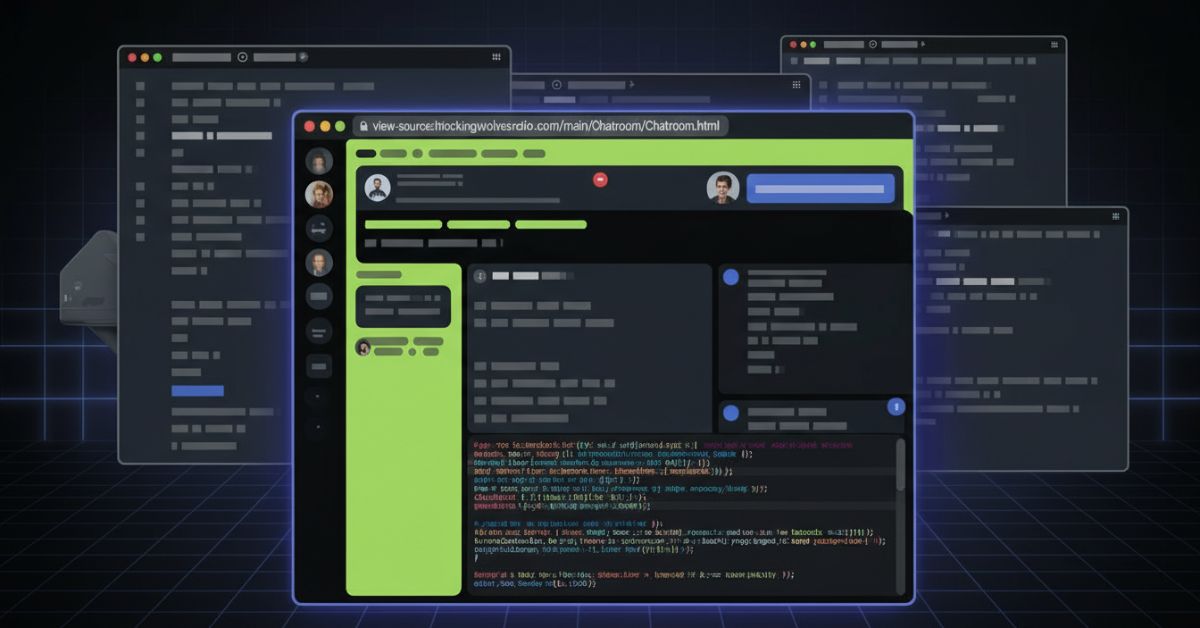
Before stepping into the community that makes Rocking Wolves Radio worth visiting week after week, it is worth understanding what this command actually does. The prefix view:source: (or more commonly typed as view-source:) is a built-in browser protocol that instructs your browser to stop rendering the polished, visual version of a webpage and instead display the raw HTML markup the server delivered. Think of it like asking a film projectionist to show you the unedited film reel rather than the finished movie playing on screen.
The URL that follows — rockingwolvesradio.com/main/chatroom/chatroom.html — points to one specific page within the Rocking Wolves Radio platform: their live listener chatroom. This is where fans gather in real-time to interact with DJs, drop song requests, react to tracks mid-set, and simply share the space with other people who understand why certain guitar riffs hit differently at midnight.
One thing worth stating clearly: viewing a webpage’s source code is entirely legal and completely safe. The HTML your browser receives when loading any public page has already been transmitted to your device. You are reading what was already sent to you. No passwords, no server-held databases, and no private user information are visible through this method. It is the equivalent of reading the ingredient list on a food label rather than breaking into the factory.
The HTML Architecture Behind a Live Chatroom
When you pull up view:source:rockingwolvesradio.com/main/chatroom/chatroom.html, you are looking at the skeleton of a real-time communication tool built specifically around a live music experience. Chatrooms can appear deceptively simple from the user side — a text field, a send button, a scrolling feed of nicknames and comments — but underneath that surface lies a thoughtfully assembled structure.
The Core HTML Framework That Makes Real-Time Chat Possible
The source typically reveals a standard HTML5 document structure: a <!DOCTYPE html> declaration, a <head> section holding metadata, stylesheet links, and script references, followed by a <body> that contains the visible interface. What separates a chatroom from an ordinary static page is where those script references point.
Real-time chat does not live in HTML alone. The source will reference JavaScript libraries — often something like Socket.IO or a WebSocket-based solution — that manage the constant two-way conversation between each listener’s browser and the central server. Every message typed, every nickname added to the feed, every live DJ announcement travels through these connections without the page needing to reload. The source exposes those connections by name, even if it cannot show you what flows through them.
Stylesheets, Branding, and the Culture of the Station
The CSS references visible in the source do more than control colours and fonts. They tell a story about identity. Music platforms that build genuinely loyal communities invest in visual consistency — dark palettes, deliberate typography, aesthetic choices that match the music being played. On a rock station like Rocking Wolves Radio, those design decisions signal something important: this space was built by people who actually care about the culture, not assembled from a generic template by someone checking a box on a to-do list.
Why the Chatroom Is the Social Heartbeat of Rocking Wolves Radio
There is something that social media giants, despite enormous engineering resources, have consistently struggled to manufacture: the feeling of being in a room with people who share your exact enthusiasm at exactly the same moment. Rocking Wolves Radio has quietly built that thing.
Real-Time Connection That an Algorithm Cannot Replicate
When a DJ drops a track that surprises a listener, the chatroom is where that jolt travels. Requests, shoutouts, reactions, gentle arguments about whether the 1983 or 1987 version is superior — all of it unfolds alongside the music itself. The chatroom at rockingwolvesradio.com/main/chatroom/chatroom.html is not a supplementary feature. It is the station’s social pulse.
Over time, regulars develop recognisable nicknames. You begin to know who shows up for the Friday night sets, who always identifies the obscure deep cuts, and who reliably turns up to request something most listeners have not heard in twenty years. That warmth is not something the platform manufactures through engagement mechanics. It builds naturally because the format encourages it.
Accessibility Without Unnecessary Friction
One of the most telling qualities of this chatroom — and one that the source structure quietly reflects — is how few barriers it places between a new visitor and the conversation. There is no elaborate registration process, no email confirmation chain, no mandatory profile creation. Visitors pick a nickname and step inside. In a digital landscape where most platforms layer identification requirements on top of one another before allowing basic participation, this simplicity feels like a deliberate act of hospitality.
What Developers Can Learn From This Source Page
For anyone learning web development or thinking about building community infrastructure around a live broadcast, view:source:rockingwolvesradio.com/main/chatroom/chatroom.html is a genuinely instructive case study.
Simplicity in Service of Purpose
The page does not need to be a heavy, complex single-page application to work beautifully. A clean HTML structure, a dependable WebSocket connection, and considered CSS can produce a chatroom that listeners return to voluntarily, repeatedly, without being prompted by a notification. Complexity introduced for its own sake tends to erode exactly the kind of casual, drop-in participation that makes a listener chatroom feel alive. Purposeful simplicity protects that.
The Boundary Between Source Code and Server Logic
Here is the part that surprises most people who try this command for the first time: what you see in the source is genuinely only half the picture. The chatroom’s actual intelligence — message storage, moderation permissions, spam filtering, user management — lives on the server and is never transmitted to your browser. The source shows you the front door and the lobby. The server runs everything behind it. Understanding where that boundary sits is one of the most important conceptual shifts a developing web builder can make.
The Bigger Picture: Niche Radio Communities in the Streaming Era
Rocking Wolves Radio occupies a corner of the internet where two things that might feel nostalgic — radio broadcasting and real-time chatrooms — turn out to feel surprisingly alive. In a media environment built around algorithmic recommendations and passive consumption, there is something unmistakably human about a DJ who selects tracks with personal conviction, talks to their audience like they are in the same room, and leaves space for the crowd to talk back.
The chatroom transforms listening from something you do alone into something you do together. A listener is no longer just an audience member absorbing a broadcast. They become an active participant in the atmosphere of the show itself. Music and conversation feed each other in a loop that no recommendation engine can recreate.
Final Thoughts
The string view:source:rockingwolvesradio.com/main/chatroom/chatroom.html might appear to be a technical oddity to anyone who has never looked behind the scenes of a webpage. In practice, it opens a conversation about how communities are constructed online, what makes a streaming platform genuinely worth returning to, and how much deliberate craft goes into building something that feels effortless to use.
Behind the markup and the script references is a space where people who love music — chosen by people who love it just as much — gather to share that feeling in real-time. That cannot be found in the source code. But the source code is what makes it possible. Next time a view-source: string appears in your browser bar, take a moment before scrolling past. What you find inside might tell you more about a community than any polished homepage ever could.